
The Psychological Hook: Why We Want to See Future Faces
Human curiosity is a powerful force. We constantly wonder about the future, especially when it comes to family and legacy [1]. I have always been fascinated by how genetics play out in facial features. Some kids look identical to one parent, while others are a perfect 50-50 split.
My journey began with a simple question: how close can software get to predicting a real biological mix? We have all seen those old, pixelated morphing tools from the early 2000s. They usually just slapped a nose onto a random baby template.
Today, machine learning promises something much deeper and more tailored. I wanted to see if the current state of consumer technology could actually respect human facial geometry. I chose to explore a modern web-based platform to see if the results felt genuine or just uncanny.
Under the Hood: Core Capabilities of the System
I decided to test Baby generator to see how modern computer vision handles genetic blending. This platform relies on advanced facial mapping algorithms rather than simple copy-paste overlays. I wanted to see if an AI Baby Generator could actually capture subtle family resemblances.
Facial Biometrics Integration
The system starts by scanning key landmarks on the uploaded photos. It measures distances between the eyes, the shape of the jawline, and the curve of the mouth. These data points are then used to create a digital skeleton of both faces.
Rather than just averaging the pixels, the algorithm attempts to simulate genetic dominance. It decides which features might take precedence in a hypothetical offspring. This approach theoretically prevents the output from looking like a weird, flat mashup.
Gender and Age Variations
Another interesting aspect is the ability to toggle different parameters. You are not locked into a single baby photo. The tool allows you to generate male or female child faces.
Additionally, you can view predictions for different developmental stages. Seeing how a face might mature from an infant to a toddler adds a layer of depth. It makes the experience feel more like a comprehensive simulation.
Step-by-Step Walkthrough: From Upload to Result
Testing this tool required a couple of high-quality portrait photos. I gathered two clear, front-facing images with neutral lighting to ensure the algorithm had the best possible data.
Phase 1: Preparing and Uploading the Parent Photos
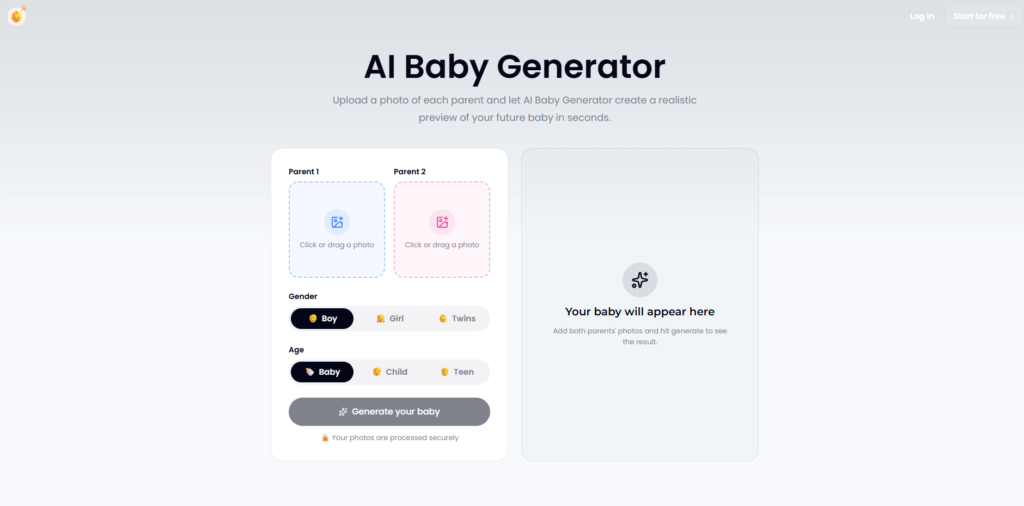
The user interface is remarkably clean and straightforward. I uploaded the first photo, which was a clear headshot with good contrast. The system processed it in about three seconds, indicating that the face detection was successful.
Next, I uploaded the second photo. The tool reminds you to avoid heavy filters, hats, or glasses. I made sure both subjects were looking directly at the camera.
Phase 2: Processing and Generation Speeds
Once the images were locked in, I selected the desired gender for the prediction. I clicked the generate button and waited. The rendering took roughly fifteen seconds, which felt reasonable for cloud-based image processing.
A progress bar kept me informed during the calculation. When the process finished, the screen revealed a high-resolution portrait. The image looked surprisingly clean, with natural skin textures and realistic eyes.
The Balanced Scorecard: What Works and What Falls Flat
No consumer-facing artificial intelligence is perfect. When operating the Baby Generator tool, I noticed several clear strengths and a few distinct weaknesses.
Where the Technology Delivers
The facial alignment is incredibly impressive. The rendered baby photo did not look distorted or cartoonish. It genuinely inherited the eye shape of the father and the chin structure of the mother.
The skin tone blending was also handled with high precision. It avoided patchy transitions, creating a smooth, unified complexion. The overall resolution of the download was crisp enough for digital sharing.
The Technical Glitches and Roadblocks
However, lighting mismatches can easily confuse the engine. If one parent photo has warm lighting and the other is cool, the output can look slightly unnatural. I also noticed that hair texture prediction is a bit of a wildcard.
It seems to default to standard straight hair patterns if the input photos have complex curls. Additionally, the software sometimes struggles with glasses. If you upload a photo with thick frames, the algorithm might attempt to blend the plastic frames into the child’s skin.
Defining the Audience: Who Belongs in This Digital Sandbox?
This tool is not a medical device, nor does it claim to be. It occupies a unique space in the digital landscape.
Expectant Couples and Daydreamers
Naturally, couples who are planning a family will find this highly entertaining. It serves as a harmless, fun way to spark conversations about the future. It is a modern equivalent of flipping through old childhood photo albums together.
Social Media Creators and Curators
Content creators are always looking for interactive, shareable media. Generating a mock child face based on two famous celebrities is highly viral material. The clean UI makes it easy to grab quick screenshots for video edits.
Family Gathering Entertainment
I can easily see this being used at a baby shower or a family reunion. It acts as an icebreaker that gets people laughing and comparing features. It brings a physical, social element to a purely digital tool.
The Market Macro View: How This Tech Reshapes Casual Entertainment
The rise of accessible neural networks has completely changed our expectations of digital media. We no longer want generic templates; we want personalized experiences.
This specific AI Baby Generator fits into a larger trend of consumer-facing personalization tools. It shows how complex biometric research has been simplified into a single-click web page. You do not need a powerful graphics card or programming knowledge to run these models anymore.
This accessibility democratizes technology. It takes concepts from academic papers and puts them directly into the hands of everyday internet users. It also raises interesting conversations about data privacy and how we interact with our own likenesses online.
The Verdict: Gimmick or Genuine Innovation?
After running multiple tests with different photo sets, I came away with a balanced perspective. The tool is undoubtedly a novelty, but it is a highly sophisticated one.
It does not offer scientific, DNA-level accuracy, and users should not expect it to. What it does offer is a highly polished, engaging, and fast way to play with facial genetics.
If you go into the experience looking for a fun, visual experiment, you will not be disappointed. It is a fascinating glimpse into how software can interpret the human face. It bridges the gap between complex science and casual, everyday fun.