
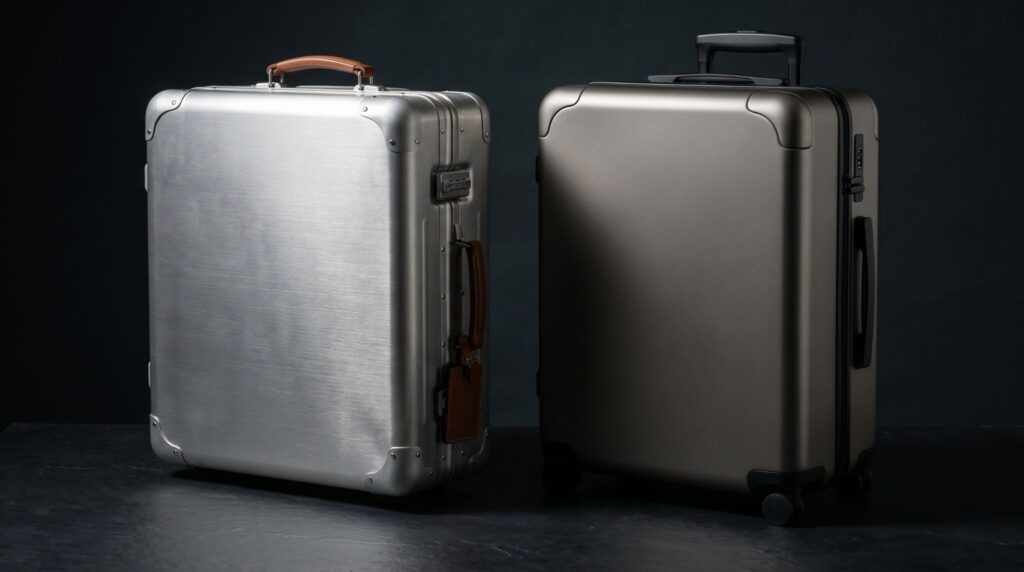
For brands positioning at the premium end of the hard-shell luggage market, the choice between aluminum and titanium is not primarily a materials science question — it is a brand positioning and manufacturing feasibility question. Both materials communicate premium. They do so differently, and they present different challenges in the sourcing process.
Why Premium Brands Choose Metal Over Plastic
Polycarbonate dominates global luggage production by volume because it is cost-efficient, versatile, and performs well across a wide range of use cases. But PC has a ceiling. Above a certain retail price point, the material’s perceived value does not support the brand positioning a premium product requires.
Metal luggage — aluminum and titanium — occupies the space above that ceiling. The structural rigidity, the surface treatment options, and the latch-closure construction communicate a durability and engineering investment that PC cannot replicate. For brands targeting the $280 and above retail tier, or corporate gifting and duty-free channels, metal is the material that earns the price point.
Aluminum: The Established Premium Standard
Aerospace-grade Series 5 aluminum-magnesium alloy is the production standard for premium hard-shell luggage. The alloy’s magnesium content improves corrosion resistance and structural integrity without increasing brittleness, and the stamping process allows precise control of shell geometry and wall thickness.
An experienced aluminum luggage manufacturer should operate in-house stamping and anodizing lines — outsourced surface treatment is a common quality consistency risk. Surface finish options for aluminum include brushed, sandblasted, and anodized, each producing a distinct visual and tactile result. MOQ for aluminum OEM production from a specialist manufacturer typically starts at 300 pieces for existing tooling.
Titanium: Ultra-Premium Complexity
Titanium is lighter than aluminum, stronger than steel, and significantly more expensive and difficult to manufacture. The material’s properties make it resistant to conventional stamping processes — forming titanium requires specialized equipment and longer production cycles.
Finding a titanium luggage manufacturer with genuine in-house capability — not just aluminum factories quoting titanium — requires verifying material sourcing and production equipment directly. Request the material grade certificate and ask to see the forming equipment during a site visit. Factories that cannot produce either have not actually made titanium luggage in-house.
MOQ and Lead Time Comparison
| Aluminum | Titanium | |
| Shell forming | Stamping | Specialist forming |
| MOQ (existing tooling) | 300 pcs | Higher, project-dependent |
| Sample lead time | 20 working days | 30–45 working days |
| Bulk production | 45 days | Longer, project-dependent |
| Surface finish options | Brushed, anodized, sandblasted | Limited vs aluminum |
| Cost index | Higher than PC | Significantly higher than aluminum |
For most premium brands, aluminum is the practical choice for volume production, with titanium reserved for limited editions or hero SKUs where the material’s exclusivity justifies the manufacturing complexity and cost premium.