
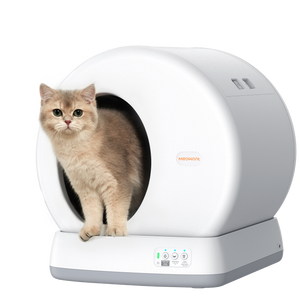
Most concerns about automatic litter boxes are reasonable, and most of them come from the same handful of misunderstandings. People worry that a motorized rake will catch a curious paw, that the unit will cycle while an older cat is still inside, or that a cheap model will fail at exactly the wrong moment. Those fears are not overblown. The mistake is assuming that the danger lives only in the machine, when in practice it is usually a mix of design limits and owner habits.
This guide takes a different route from a standard buying checklist. Instead of listing features, it examines the specific things owners get wrong and the ways a safe self cleaning litter box is built to absorb those errors. If you already own an automatic box, or you are about to buy your first one, the following missteps are worth reviewing before your cat investigates the new addition.
Mistake One: Trusting a Single Sensor
The most common misunderstanding is that “it has a sensor” means “it is safe.” A single infrared beam or a lone load cell can be defeated by ordinary cat behavior. A cat that enters and freezes might sit under a motion threshold; a cat that steps in lightly might not trigger a weight plate calibrated for a full-grown animal. When only one signal exists, there is no second opinion to catch the failure.
Look for designs that cross-check at least two independent inputs before starting a cycle, and that treat disagreement as a reason to wait rather than to proceed. The pause after the last detection also matters. A generous delay, followed by a slow first sweep, gives a cat time to leave even if it was missed on entry. If a product page lists sensors without explaining how they combine, that is a question worth asking before you buy.
Why “It Stopped Once” Is Not Proof
Owners often report that the box paused when their cat walked past, and treat that as a full safety audit. One successful pause tells you the sensor works in one scenario. It does not tell you how the machine behaves when the cat lingers at the entrance, approaches from the side, or jumps out mid-cycle. Testing should be deliberate: watch a cycle from several angles, have someone else walk near the unit, and confirm that every interruption produces a full stop rather than a brief hesitation.
Mistake Two: Ignoring the Material Story
Safety is not only about moving parts. The interior surface your cat stands on and the waste drawer that holds soiled litter are both reservoirs for bacteria if they are porous or impossible to clean. Thin plastic that scratches easily gives bacteria a place to settle, and a drawer that does not seal lets odor escape into the room, which can push a sensitive cat to eliminate elsewhere.
A safe self cleaning litter box uses smooth, non-porous surfaces, rounded interior edges, and parts that lift out for washing without tools. When you evaluate a model, check how many components come apart and whether the manufacturer publishes material details. A brand willing to describe its plastic and its seals is usually a brand that expects owners to inspect them.

Mistake Three: Skipping the Adjustment Period
New owners frequently unbox the unit, plug it in, and expect the cat to adopt it the same day. Some cats do. Many do not, and a cat that is startled during the first encounter may avoid the box for weeks. That avoidance is the real safety risk, because a cat holding its bladder to avoid a frightening machine is a veterinary problem waiting to happen.
Introduce the box with the power off. Let the cat sniff, step in, and dig in a stationary drum. Run a cycle by hand while the cat is in another room, then let it watch from a distance. Only after the cat approaches the unit calmly should it run automatically while the cat is nearby. This sequence costs a few days and prevents most stress-related refusals.
Watch the Exit, Not Just the Entry
Owners tend to watch the moment their cat steps in. The more revealing moment is the exit. A cat that lingers with its head in the opening, or that turns back to check the drum, is signaling uncertainty. A well-designed cycle will not begin while any part of the cat is still inside the entrance tunnel. Confirm that behavior yourself rather than relying on the manual, because firmware updates and settings can change timing.
Mistake Four: Letting Maintenance Slide
The sensors that protect your cat become less reliable as dust and litter residue build up. Infrared windows cloud over, weight plates shift when the base is nudged, and hair wraps around axles until the rake strains. None of these failures announce themselves. The machine keeps cycling, just with a wider margin for error.
- Wipe sensor windows weekly with a dry cloth and re-seat the drum after cleaning.
- Inspect the underside and axles monthly for wrapped hair, especially with long-haired cats.
- Replace cracked liners and stiffened seals before they fail, not after.
Keep the power cord routed out of reach as well. A chewed cord is a hazard that has nothing to do with sensors, and it is entirely preventable with a little furniture rearrangement. Brands such as Meowant include cord-routing guidance in their setup materials, and following it takes less time than the problem it avoids.

Mistake Five: Misreading the Failure Modes
When an automatic box misbehaves, the first response is usually to assume the sensor is broken. In practice, the sensor is rarely the culprit. A unit that cycles while a cat is nearby is more often mis-leveled on an uneven floor, weighed down by an oversized litter load, or running firmware that has not been updated. All three distort the signals the machine uses to decide whether the drum is clear.
The productive response is to reset the basics before calling support. Empty the drum completely, check that the base sits flat on a hard surface rather than on carpet, and recalibrate following the manual. If the machine still cycles at the wrong moment, stop using automatic mode until the problem is resolved. Running a doubtful machine “just for a day” is exactly the kind of gamble that ends badly.
What a Reliable Cycle Should Look Like
Familiarize yourself with the normal sequence so that a deviation stands out. A solid cycle begins with a pause, starts slowly, sweeps in one direction, returns to a resting position, and stops completely. Any variation, such as a jittery start, a rake that reverses halfway for no reason, or a motor that keeps humming after the drum has stopped, is a signal to investigate. Owners who know the baseline catch problems weeks before a failure becomes dangerous.
Mistake Six: Assuming One Box Fits Every Cat
Body size, age, and temperament all shape how safe a machine is for a particular animal. A large or elderly cat may struggle to turn around inside a compact drum, and a nervous cat may bolt at the first sound of the motor. Manufacturers publish entrance heights and interior dimensions for a reason; measure your cat against them rather than against your living room’s available floor space.
Multi-cat households need extra thought. Two cats sharing one automated box may trigger overlapping cycles, and a timid cat may be displaced by a bolder one. A second box, even a manual one, reduces pressure and gives each animal an exit route. Automation should lower the household’s workload, not concentrate stress on the least confident cat in the home.
Mistake Seven: Treating the App as the Safety System
Connected litter boxes invite owners to rely on notifications. The phone tells you the drawer is full, the drum was cleaned, or a cycle was interrupted, and that feels like oversight. Notifications are useful, but they are a record of what happened, not a safeguard against what is about to. A dropped connection, a stale refresh, or a muted alert can leave you confident while the machine is doing something you cannot see.
The physical controls deserve just as much attention as the app. Find the stop button, know whether it cuts power to the motor or merely pauses the cycle, and confirm that it works when your phone is in another room. On some models the emergency stop is a simple press; on others it requires holding a sequence. Learn which one you own before you need it, because in a real moment there is no time to read a menu.
Notifications also create a subtler trap. Owners begin to trust the summary instead of watching the cat, and the cat’s behavior around the box is a far more sensitive instrument than any app. A cat that lingers, hesitates, or waits until you are present is telling you something the dashboard will never report.
Safety Is Shared Between Design and Habit
The pattern across all these mistakes is the same. Owners expect the machine to carry the full burden of safety, and machines cannot do that. Sensors need redundancy, surfaces need to be cleanable, and cats need time to adjust. When those pieces are in place, an automatic box is genuinely convenient. When any one is skipped, the owner unknowingly transfers risk back onto the animal.
Before you buy, ask how many independent sensors confirm the box is empty and how the machine reacts when they disagree. After you buy, supervise the first week, keep the unit clean, and watch for hesitation at the entrance. Those two habits, one at purchase and one at home, do more for your cat than any single feature on a spec sheet.