
The easiest way to like an AI music platform is to run one strong prompt, get one satisfying result, and stop there. But that is not how real creative work happens. Real work asks harder questions. Can the platform help you generate again tomorrow? Can it handle several variations of one concept? Can it stay useful once the first moment of surprise fades? That is why I wanted to test AI Music Generator under a different standard: repeatability.
Repeatability is one of the most important and least discussed measures in generative music. A tool can be exciting once and still fail as a workflow. It can create a convincing clip for a demonstration and still become frustrating when a creator needs options for a campaign, a revised hook for a lyric draft, or multiple tonal versions of the same concept. In my observation, this is where many products quietly reveal what they really are. Some are demo machines. A smaller number are actual work tools.
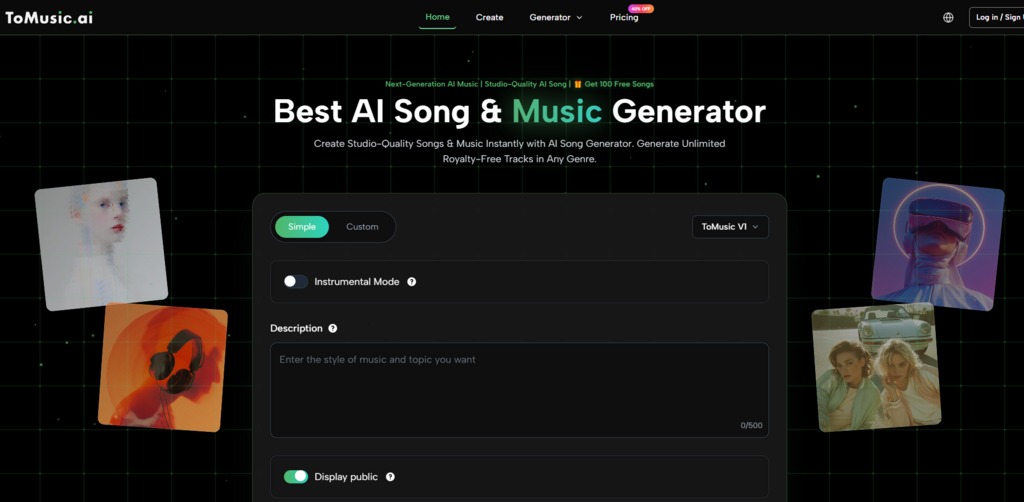
ToMusic is interesting because its public design suggests it wants to belong to the second category. It supports prompt-based input and custom lyrics, includes multiple generation models, and stores outputs in a structured music library. Those are not just product details. Together, they imply a platform built for repeated creative testing, not only one-off generation. So I decided to evaluate it on that basis.
The core question of my test was simple: does the platform help the user build creative momentum across several rounds, or does each generation feel like starting from zero again? That difference matters because almost all serious creative work depends on informed repetition.
Why Repeatability Is the Real Test of Music AI
There is a reason this standard matters more than isolated quality. Most users do not need one song from nowhere. They need a path from uncertainty to several workable options.
Creative Work Is Comparative by Nature
A creator rarely knows the best musical direction before hearing alternatives. Even skilled people discover quality through contrast.
One Good Result Can Be Misleading
A single strong generation may tell you very little about whether the tool supports actual decision-making. It might only mean that one prompt aligned well with one interpretation.
Multiple Useful Results Reveal More
If a platform can produce several distinct but credible versions of the same idea, it becomes much more valuable. It begins to support curation instead of random luck.
Modern Creative Teams Need Range
This is true not only for musicians. A brand team may want three emotional versions of the same campaign track. A creator may need a softer edit for one platform and a more energetic edit for another. A songwriter may want to hear whether a chorus works better as intimate or anthemic.
A repeatable system is what makes those choices possible.
How I Designed the Stress Test
To evaluate repeatability, I avoided judging the platform on one successful output. I built the test around repeated creative pressure.
I Reused Core Ideas With Small Changes
Instead of inventing unrelated prompts every time, I kept certain ideas constant and changed mood, intensity, purpose, or lyrical framing. This allowed me to see whether the platform could produce meaningful range from similar source intent.
I Tested Both Prompt-Only and Lyric-Led Inputs
This mattered because repeatability should apply across more than one workflow. A platform that only works consistently in one input mode is less flexible than it first appears.
I Paid Attention to What Happened Between Attempts
Did the process feel cumulative? Did one result inform the next? Or did every generation feel detached from the last one? This may be the most important practical question of all.
The First Pattern I Noticed Was About Prompt Discipline
At the beginning of the test, I intentionally used broad prompts. Later, I tightened them. The difference was revealing.
Loose Prompts Produced Looser Variation
This may sound obvious, but it matters because repeatability is partly a property of the user’s own creative method. When my prompts were vague, the outputs sometimes felt like they occupied the same general zone without giving me strong comparative value.
A Broad Emotional Cloud Is Not Enough
If a user simply asks for “uplifting pop song” several times, the platform may respond with listenable variations, but the differences may not be strategically useful.
Specific Framing Produces Better Contrast
When I clarified role, mood, pacing, and intended effect, the variations became more valuable. The platform responded better when each attempt had a clearer purpose.
This Is a Good Sign Rather Than a Bad One
It suggests that ToMusic does not flatten everything into the same outcome. Better direction produces better differentiation. That is what users should want in a creative system.
What Repeat Generation Felt Like in Practice
The next question was whether multiple attempts actually felt worth doing.
Second and Third Passes Often Added Real Value
In my observation, the first result was often informative, but not always the most useful. The second or third attempt frequently revealed a clearer emotional match or a more practical structure.
This Mirrors Real Creative Behavior
Artists, editors, and writers rarely choose perfectly on the first attempt. A system that supports repeated testing aligns more naturally with how people already work.
It Also Reduces the Fear of Failure
When the user knows that trying again is normal and manageable, each imperfect output feels less discouraging. That psychological effect should not be underestimated.
The Platform Supported Variation Better Than Novelty Alone
The repeated tests made ToMusic feel less like a machine for isolated surprises and more like a tool for controlled experimentation. That is a meaningful distinction. Controlled experimentation is what creative professionals actually need.
Why the Multi-Model Design Matters Under Pressure
Publicly, ToMusic offers multiple music models with different strengths. During a repeatability test, this becomes especially important.
Different Models Create Different Kinds of Variation
If all variation depends only on rewording prompts, the user can quickly become trapped in guesswork. A multi-model system introduces another creative axis.
This Gives the User More Strategic Choices
Instead of asking only, “How do I rewrite the prompt?” the user can also ask, “Which interpretive engine better suits this idea?” That is a stronger workflow.
It Helps Separate Prompt Problems From Model Problems
This may be one of the most underrated benefits. When one result disappoints, the user is less likely to assume the concept itself was wrong. They can test whether the issue was interpretive fit.
Model Diversity Supports Better Comparative Thinking
In my testing, the multi-model structure made repeat generation feel more purposeful. It added a sense that several plausible routes existed, which improved both experimentation and confidence.
Testing the Same Lyrics in Different Ways
One of the most interesting repeatability tests involved reusing the same lyric material with different musical framing.
The Words Behaved Differently Under Different Direction
This is where the platform became especially valuable. The same text could feel more intimate, more cinematic, more restrained, or more direct depending on how the generation context was shaped.
That Is Deeply Useful for Writers
A songwriter often does not know what kind of song their words should become until they hear several possibilities. A tool that accelerates that discovery has real creative value.
It Also Helps Teams Discuss Creative Direction
If several versions can be produced from one lyric base, collaborators have something concrete to compare. Discussion becomes more grounded and less abstract.
This Is One of the Best Arguments for Text-Based Music Tools
Later in my testing, I found that Text to Music is most compelling when it is treated as a comparison engine for creative intent. It does not only convert language into sound. It helps expose the hidden options inside the language.
The Music Library Changed the Nature of Iteration
A repeatability test would be incomplete without considering what happens after generation.
Saved Outputs Turn Repetition Into Process
Publicly, ToMusic’s library stores songs with titles, tags, descriptions, lyrics, and generation parameters. Under repeated use, this becomes extremely valuable.
Without Organized Memory, Variation Becomes Noise
If several generations are produced but poorly preserved, the user may remember only that “something close happened once.” That is frustrating and inefficient.
With Context, Comparison Improves
When outputs are stored with meaningful details, users can look back and understand why one version felt stronger. This supports learning, not just browsing.
The Library Encouraged Longer Sessions
Because prior attempts remained visible and interpretable, I felt more willing to continue testing. That is an important sign. Good workflows create stamina. Poor workflows create exhaustion.
Where ToMusic Was Strongest in the Stress Test
After several rounds of repeated generation, a few strengths became clear.
It Handles Iteration Better Than Many Casual Tools
Some platforms feel optimized for instant impact. ToMusic, by contrast, appears better prepared for repeated exploration.
It Makes Creative Range More Accessible
Through prompts, lyrics, and multiple models, the platform gives users several ways to search within one idea rather than abandoning it too quickly.
It Supports Comparison With Real Structure
The combination of model choice and library storage turns repeated attempts into something closer to a method than a gamble.
It Rewards Users Who Think in Variants
This is important because modern creative work often happens in variants: shorter edits, mood changes, audience-specific versions, and multiple tonal options. The platform feels compatible with that reality.
Where the Stress Test Exposed Limits
No serious review should hide the weaker points.
Repeatability Still Depends on User Clarity
A platform cannot invent structure out of extremely vague direction forever. The more specific my intention became, the more useful the repeated outputs felt.
The Tool Is Not a Substitute for Taste
Users still need to decide what kind of difference they are seeking. The system helps explore options, but it does not define creative priorities for them.
Weak Inputs Still Create Waste
If the user does not know what they want to compare, repeated generation may become less helpful. The platform works best when the person brings at least a rough hypothesis.
Some Iterations Will Be Functional Rather Than Inspiring
Not every repeated output felt revelatory. Some were useful mainly because they narrowed the search. That is still value, but users should recognize it as part of the process.
Several Rounds Can Be Necessary
This is not a defect so much as a condition of generative creativity. People looking for perfect first-pass output may feel impatient. People willing to compare and refine are more likely to benefit.
Who Will Appreciate This Strength Most
Repeatability is not equally important to every user. But for some groups, it is central.
Songwriters Testing Emotional Range
A chorus can feel very different across multiple interpretations. These users are likely to benefit greatly from the platform’s repeatable structure.
Content Teams Making Variants
Marketing and media teams often need several versions of one core idea. A tool that supports variation quickly is valuable in that environment.
Independent Creators Learning by Comparison
Beginners often improve faster when they can compare several plausible outcomes rather than obsess over one attempt.
My Final Judgment on ToMusic After Repeated Testing
The strongest conclusion from my stress test is that ToMusic feels built for ongoing use more than one-off amazement. It does not remove the need for judgment. It does not guarantee brilliance on the first try. But it gives users a practical environment for repeated creative testing, and that matters more than most headlines admit.
In real work, quality often emerges through controlled repetition. You test one version, hear what is missing, adjust the framing, compare again, and move closer. In my observation, ToMusic supports that cycle unusually well. Its prompt and lyric flexibility, multi-model structure, and organized library make it easier to keep exploring without feeling lost. That is why I think it deserves to be treated as more than a novelty platform. Its real strength is not just that it can generate music. Its real strength is that it can help users search for the right music with more clarity and less friction.