
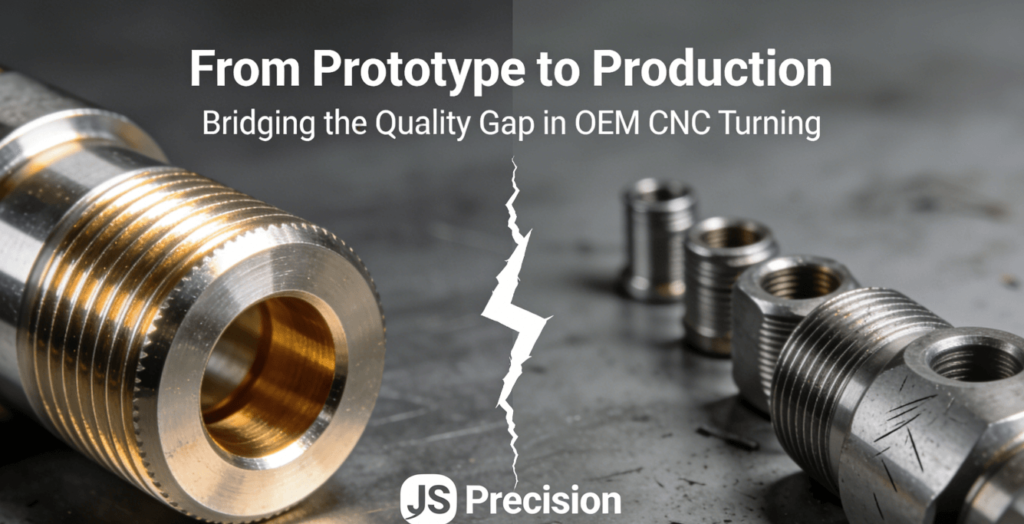
The production gap-that perfect prototype fails during mass production-remains one of the least favorite surprises in manufacturing. That’s because a prototype will normally focus on functional validation, while OEM CNC Turning Services necessitate stability, repeatability, and cost control. Closing this gap involves the blend-in of manufacturing insights into the engineering design phase and choosing partners that can collaborate.
Why a Perfect Prototype Can Become a “Trap” for Production Failure?
The goals of prototyping and mass production are fundamentally different. Prototyping allows for speed and flexibility, while production requires rigorous consistency. Issues such as overly tight tolerances or complicated features that are acceptable in a prototype can result in high scrap rates and delays when scaled.
According to the AmericanNational Society of Professional Engineers (NSPE), design needs to consider larger implications, including manufacturability. Engaging a CNC machining expert early in the design review phase provides critical DFM analysis to identify production risks and optimize the design for scalable manufacturing .
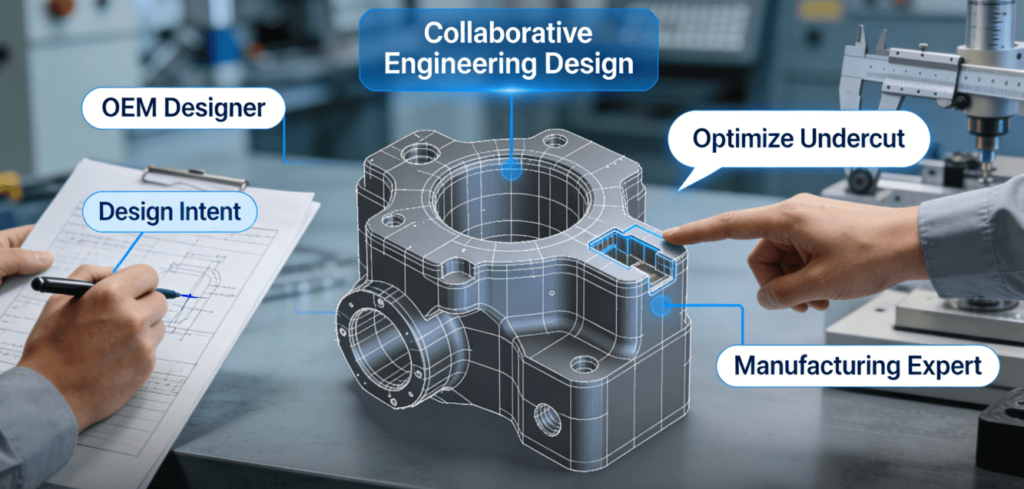
How Professional OEM Turning Services Lock in Production Success at the Design Stage
It is when OEM CNC turning services suppliers become engaged in Early Supplier Involvement (ESI) that True Value is created. This collaboration is key to effective manufacturing solutions.
Design for Manufacturability: The Collaborative Bridge
Professionals in OEM CNC turning machining analyze designs to suggest improvements, such as simplifying features or optimizing tolerances. This collaborative engineering design process ensures parts are not just functional but also efficient to manufacture at scale.
Technical Decision Making and Knowledge
Proper technology choice is critical. For example, deciding between a precision OEM CNC turning center and a conventional lathe machine might have a tremendous difference in efficiency, especially in the case of more complex components. Knowledgeable technical decisions are vital.
Evaluating OEM Turning Partners: Which Capabilities Matter More Than Price?
Explanation of the International Association of Automation (ISA) White Paper on “The Value of Data Continuity in Smart Manufacturing,when assessing suppliers for OEM CNC turning services, it is important to not only focus on costs. Critical factors include engineering collaboration capabilities, robust process control systems, and the ability to handle OEM large CNC turning services. Strong Industrial Engineering expertise is particularly valuable for optimizing production processes and achieving the lowest total cost, not just a low unit price. Partners should demonstrate data-driven continuous improvement, aligning with smart manufacturing principles.
Conclusion
Narrowing the production gap means looking at production as an extension of design. The best way to succeed in the market is by choosing the OEM CNC turning parts partner with strong engineering collaboration capabilities.
Have you received optimization recommendations for your next project in the manufacturing production pipeline? Do you have a project you’d like to have assessed for manufacturability? Reach out to an expert and get your project analyzed.
Author Biography
The author is an engineering consultant in the field of manufacturing engineering at JS Precision, working in the OEM CNC turning services sector over the past ten plus years, focusing on the engineering design to scalable production.
FAQ
Q1: Does Early Supplier Involvement (ESI) add to initial costs?
A: No. ESI is a strategic investment because it avoids high changes in the future, thereby reducing the cost of projects.
Q2: What is the value of IATF 16949/AS9100D certification?
A: It means that the supplier is able to maintain a strong control and traceability system, which is beyond the quality standards.
Q3: In turned parts, especially large ones, what’s important?
A: Emphasize hardware capacity, experience with similar components, or knowledge of Industrial Engineering to deal with difficulties such as deformation.